

Why so many companies lose profit to OEE
The manufacturing industry has historically been a hotbed of innovation, constantly seeking ways to improve efficiency and productivity. Developing, refining, and applying measurement tools plays a major part in these improvements.
Overall Equipment Effectiveness (OEE) is an innovative metric used to calculate a simple but essential predictor of overall performance. It provides valuable insights that allow manufacturers to benchmark, track, and improve their production efficiency. It’s simple yet comprehensive, making it a key tool in the arsenal of modern manufacturing.
Why, then, do so many companies fail to achieve the OEE scores necessary to maximize productivity and profit?
Like many simple but effective tools, OEE is often forgotten, or assumed to be someone else’s responsibility, and while it’s simple to calculate, it can be perceived as difficult to implement.
The Benchmark
In an ideal world, a company manufactures only good parts, as fast as possible, with no downtime, consuming all available machine time, and its OEE is 100%. In reality, an OEE score of 85% is often considered a benchmark for world-class performance. Only around 5% of manufacturing organizations achieve this.
It’s estimated that the average OEE level worldwide is between 40% and 60%. According to OEE.com, more companies have OEE scores lower than 45% than those with scores higher than 85%.
These figures are averages or estimates, and there isn’t a single perfect OEE score or universal industry standard that every company can use as a reference point. Sometimes, the best benchmark is a company’s demonstrated historical performance. Actual OEE scores will vary depending on factors such as industry, equipment, operational practices, and workforce skills. But every manufacturing company should know their benchmark and should strive for continuous improvement in productivity, beginning with OEE.
The Breakdown
In layman’s terms, OEE is like the report card of a machine or process in a manufacturing plant. It tells you how well the equipment is performing by considering three main elements: availability, performance, and quality.
Imagine a student. The student’s overall grade (OEE) depends on their attendance (availability), how well they do on tests (performance), and the quality of their assignments (quality). OEE= Availability x Performance x Quality
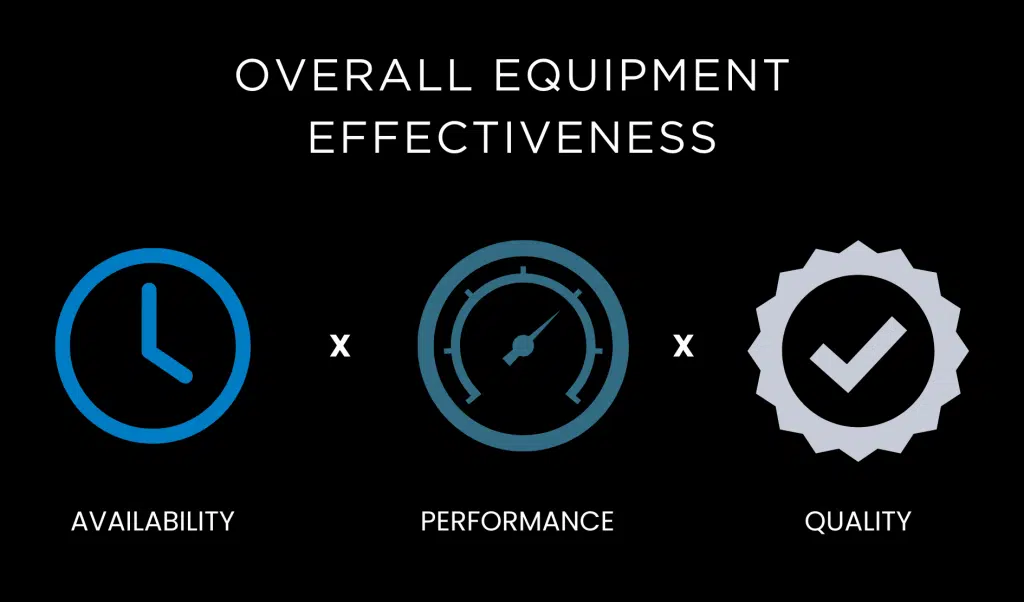
Using OEE helps manufacturing companies identify the extent to which inefficiencies exist in their processes. With this knowledge, they can target efforts to address improvements and increase production, decrease waste, and improve profitability.
The Importance
Why is it critical to maximize Overall Equipment Effectiveness (OEE)?
- Increased Productivity: Improving your OEE score directly correlates to increased productivity. A higher OEE score means your equipment is available more often, runs at optimal speed, and produces quality parts.
- Cost Reduction: Optimizing OEE can reduce costs associated with downtime, slow running equipment, and defective parts.
- Improved Quality: While the quality aspect of OEE is typically the most difficult to improve, it’s an important goal because it reduces waste and rework costs.
- Increased Capacity: Maximizing OEE can increase capacity, making it possible to produce more without additional investments.
- Performance and Production Insight: OEE provides a clear picture of how effectively your manufacturing process is running. It helps identify productivity losses, providing valuable insights for improvement.
- Increased Competitiveness: A higher OEE score can make a company more competitive by enabling it to produce goods more efficiently.
- Improved ROI: By maximizing OEE, businesses can reduce machinery costs and achieve a better return on investment (ROI).
- Unlocked Working Capital: By improving OEE, manufacturers can unlock working capital by reducing waste, increasing productivity, and addressing backlogs more efficiently.
OEE provides valuable insights into manufacturing processes, enabling businesses to make informed decisions and strategic improvements. Maximizing OEE can lead to increased productivity, reduced cost, improved quality, and enhanced profitability.
The Steps to Improvement
To achieve maximum OEE, companies need to develop a systematic approach to key performance metrics accompanied by dynamic management. Building this approach into processes, performance measurement tools, and training schedules with supporting leadership behaviors is critical to sustaining continuous improvement.
- Invest in Training: Training operators on correct machine usage and maintenance can help prevent machine faults and downtime. Training front-line managers on the importance and calculation of OEE ensures this tool is tracked and utilized.
- Improve Scheduling: Implementing a proactive maintenance strategy can help prevent equipment failure and reduce unplanned stops.
- Improve Supply Chain Efficiency: Ensuring a steady supply of just-in-time parts can prevent delays and improve availability.
- Address Labor Issues: Strategies to handle labor issues can include cross-training workers, improving working conditions, or using automation to address labor shortages.
- Implement Quality Control Measures: Quality control measures can help detect and rectify quality defects early, thus improving the quality factor of OEE.
- Improve Variance Reporting and Solutioning: OEE variance reporting can help guide management efforts toward items of largest magnitude while the means and methods used to solution can be equally important depending on the type of variance leaders encounter (Training, Method, Instruction, or Escalation).
Maximizing OEE requires addressing issues related to operator training, machine faults, supply chain efficiency, labor, and quality. By deploying operational management tools, manufacturing companies can significantly improve their OEE, leading to increased production efficiency and enhanced profitability.

